My first idea was to build a version of Bill Schnieder’s NYO&W – a penurious railroad in the north-east of the US with a heavy British flavour, albeit in the guise of American rolling stock and freight.
Acting like the M&GN, the NYO&W was a bridge route between the New Haven and Lehigh Valley – a quick cutover to diesel power in the late 40’s was not enough to save the company from bankruptcy and dissolution in 1957.
All the diesels on the NYO&W are available in HO. GE-44, FT, F3 and NW2 – and a Lehigh Valley RS-3.
Ballard Terminal Railroad
Here’s a great little shortline railroad that you can model totally to prototype in a small office going ’round the walls, or if you compress the long blank sections of straight track to 1′ or so, probably just along one wall. The Ballard Terminal Railroad:
http://www.docwightman.com/railroad…rideonbtrr.html
The whole thing is less than 3km including plain stretches of track. If you check the website there were loads more industries that are no longer served such as metal works, chemical plants and LCL team tracks. If you wanted to model it as-is these days you’d need 8 switches, half a dozen yard length of tracks, a single SW1 switcher (about $40), 4 gravel hoppers and 2 Refridgerated Box Cars.
Operation would be to warm up the loco, backing up into the end-of-line, running to the Gravel Co. and picking up the filled hopper (the empty one is in ‘the yard’) and a Reefer from the Fish co and taking it to the interchange. Then reverse back and put the empty gravel car from the yard into the gravel co. to be filled and attach it at the interchange. Then a BNSF switcher comes down off the mainline to pick up the cars at the interchange, and drops off a new pair to be re-sorted into their correct places. Think about adding more industries but keeping the same amount of trackage and how you’ll have to do lots of fun juggling.
Walla-Walla Valley
WWVR is a shortline in the Pacific Northwest. My original plan was great for a modern shortline, but it didn’t really fulfill my need for 1st Generation diesels like RS-3’s, F3’s and GP7’s. By modelling an early diesel era where small industry and dense trackage was common, I can combine that with furious switching:
I think I’ve made a happy medium by merging the Layout Design Services’ Heart of Georgia Railroad plan with the Walla Walla Valley Railroad plan for semi-rural switching and shunting.

Eastern Alabama Railroad
More trawling through shortline websites lead me to the Eastern Alabama Railway and with a little tweaking last night I knocked up a passable resemblance to aforementioned shortline. Here we go!

Bottom left corner is a functional connection but doesn’t exist in real life, obviously.
The line starts at Gantt’s junction where it serves a Marble/Limestone quarry, which strangely seems to ship out via hoppers, and an old Fertilizer plant.
It then heads towards the town of Sylacauga, serving a printing firm called American Color Graphics before the city outskirts. Inside the city, it has a 6 track yard and an interchange with the Norfolk Southern. An Ice Cream factory gets corn syrup shipped in by rail fairly often, and a newly built Purcell Fertilizer plant is also served.
North-East of Sylacauga it’s cotton fields and woodland for 15 miles (a nice 20″ 1/4 turn does that for me) over a small creek with a wood trestle, and into Sycamore where it passes by Avondale Mills. In reality this is burnt out and derelict, but I’ll either model the spur for car storage or have it as a low focus customer with chlorine, plastic pellets and boxcar carried cotton bales.
The line finishes up at Talledega with an interchange with the CSX. In reality the Conoco Oil dealer there is not served by rail, but I’m keeping that spot open for a generic industry – propane, oil, etc.
EARY carries 12,000 carloads yearly – which translates to about 40 a day, which combined with bridge traffic seems a pretty reasonable amount of operations.
Cat Mountain & Santa Fe
As a slight diversion to the scheduled programming, a friend on RMweb pointed me in the direction of a set of articles about the creation and running of an ATSF branch, the South Plains division of the Cat Mountain & Santa Fe. So, I decided to see if I could fit it into my layout space and existing baseboard construction:

Going with the existing naming scheme, the left hand side is ‘Industry Yard’, with two industries, a yard/siding and a small engine facility. The right and side is ‘South Plains’ with some more industries (including large grain facility with silos, etc.) and a BN interchange.
It’s got more operational flexibility, but lacks off layout staging. It’s got fewer industries, but much more capacity for actual switching.
Going by the article – there are 27 car spots in South Plains, and about 25 in Industry Yard (I’ve actually left out the smallest yard track in Industry Yard so it fits my 16.5″ baseboard width). Two jobs run each shift – the first is switching industries, recieving interchange cars from BN in South Plains and blocking them for transfer to Industry Yard. The second is switching the industries/yard tracks in Industry Yard and blocking cars both for transfer to South Plains/BN Interchange and for transfer to ‘the rest of the world’ via the mainline out the other side of IY.
All in all, I’m intrigued!
Virginian Stone Coal Creek Branch
The Virginian Railway had a motto of paying upfront for the best – the best infrastructure, the best locomotives and the best routes. Indeed, the Virginian’s right of way is the preferred route of the Norfolk Southern through it’s old stamping ground. The VGN was chartered in 1907 and was merged with the Norfolk & Western in 1959.
The VGN purchased 66 diesels in 1954 (24 H24-66 Trainmasters and 42 H10-44 switchers) and a couple dozen electric locomotives, with a striking yellow and black wasp stripe scheme.
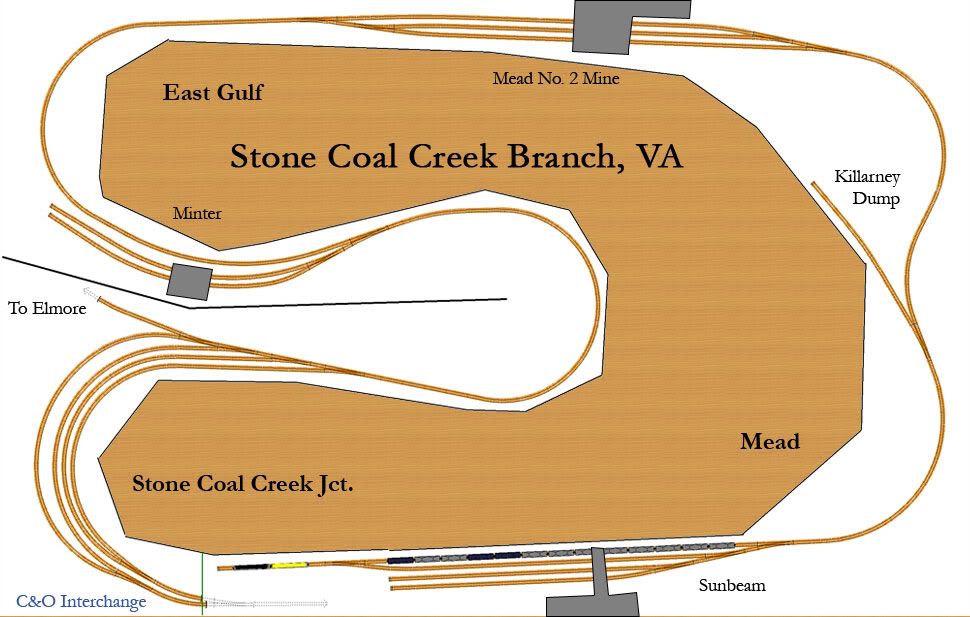
The Stone Coal branch of the Virginian served several mines around Mead and East Gulf from Elmore on the 3rd Subdivision. The Chesapeake & Ohio had full trackage rights over the branch, but preferred to drop hoppers off at Stone Coal Junction for the VGN to do the legwork with.
Motive power would be Trainmasters, either single or paired or Mallet articulated 2-6-6-2’s (although these would require turning by hand at the end of the branch). Hoppers would be 50 ton two bay and 70-ton three bay hoppers.
At the start of an operating session C&O locos would drop off empties at the interchange tracks at Stone Coal Junction and return light engine back to their train off-layout. A little later on, a Norfolk & Western (or VGN) mine run would depart from Elmore and head towards Stone Coal Jct. Here it would cut in the C&O empties, and depart down the branch, distributing as appropriate. In reverse it would bring the loads, cutting out the C&O loads en-route for the interchange and depart with the remaining loads to Elmore’s division point yard.
On the face of it the operation could be simple, however there are many destinations of the hoppers. Each track in a coal tipple is for a different grade of coal with the largest pieces furthest away from the start of the conveyor. Therefore, each track in each tipple could be considered a separate industry (since they give different products, in theory) and correspondingly each cut of cars under the tipples could be considered for separate destinations.
Interestingly the lack of buildings does mean that I can be flexible with the layout’s timescale. I could model the early 50’s with Mallet 2-6-6-2’s and 50-ton two-bay hoppers, or the transition era with VGN’s wasp-striped Trainmasters, or the post-N&W takeover with the stealth-black scheme. Alternatively, the same arrangement continued through to the present between Norfolk Southern and CSX so potentially I could run GE AC6600CW’s from CSX and EMD SD60’s from Norfolk Southern.
Twin Cities & Western
Twin Cities & Western RR – The Perfect Modern Prototype?
History:
The TCWR is a shortline in Minnesota, it started operations in 1991 over the former Soo Line from the Twin Cities (previously part of the Milwaukee Road’s Pacific extension). It has trackage rights east into Millbank in South Dakota via BNSF (formerly BN) and the Twin Cities suburban area over CP rails. Agricultural products are the main revenue stream given the prairie-land geography and rural nature of the state.
Traffic:
The line is largely agricultural, with wheat, beans, grains, corn, etc. being the main source of revenue. However, growing proportion of ethanol and ethanol-production byproducts, coal, canned foods are also moved. Their website lists the traffic base as ” coal, grains (corn, wheat, barley), soybeans, sugar, beet pulp pellets, lumber and other forest products, canned vegetables, edible beans, molasses, DDGs, fertilizers, crushed rock and agricultural machinery. “
Motive Power:
The TCWR has 9 re-engined EMD’s, several mothballed slugs and a CF7. They take advantage of leasing services for extra power as needed from ILCX, and some TCWR trains are run by both UP and BNSF power. The TCWR closely works with the Minnesota Prairie Line and the MPL has trackage rights over the western half of the TCWR system from the connection at Norwood. The MPL and TCWR have an all over maroon paint scheme, with yellow serif ‘MPL’ and ‘TCWR’ on the long hood, and with cab front and nose all yellow with maroon hazard stripes. The TCWR, MPL and Red River Valley Western railroads are all affiliated under the same Chief exec, and so it’s not rare to see the power mixed up in consists on any of the trains.
The locos are a mixture of GP20C’s and GP15C’s. GP20C’s are re-engined GP20’s with Caterpillar diesel prime movers. The GP20’s themselves were 2000hp upgrades of the original GP7/9 EMD locos of 1950’s vintage.The GP15C’s are also re-engined EMD GP15-1’s with Caterpillar diesels but retain their original power rating of 1500hp.
Breakdown
The main elements of this railroad are broken down as I see it as follows, east to west. The trains are described following:
– Montevideo and East – The Milbank turn passes through here, and the Intermodal originates from the TOFC facilities here.
– Glencoe – Small engine facilities and a siding, and several customers with several jobs originating and terminating here both east and west.
– Junction with Minnesota Prairie Line at Norwood and siding at Cologne – Source of the DDG and Ethanol unit trains and interchange traffic
– Hopkins – Yard/Sidings and the originating point of the main train of the railroad, the St. Paul turn – which also terminates here, and all traffic to the Class 1’s passing through.
– Cedar Lake Jct. – connections to St. Paul (CP), Bass Lake Jct. to Minneapolis (UP and BNSF via MNNR)
– Skunks Hallow switchback to Savage (Minnesota River barge connection)
– St. Paul and Minneapolis urban running over CP / UP / BNSF / MNNR trackage.
CLIC Charts
Some CLIC charts I made up by following the tracks on google earth and extrapolating photographs onto track layouts:
East is left, orange are grain elevators and the blue slashes denote long ass gaps between sections. There are more towns than noted, but which don’t have any rail served customers:
A
B A
A
C B
B
Trains:
5:30am Savage Turn – The TCWR has a river barge connection at Savage which is one of the main recievers of grain grown by TCWR’s clientele. The train originates at Hopkins, picking up the 25-30 cars from the Glencoe turn and uses a switchback to access CP trackage proper called ‘Skunk Hallow’ – the early start is so that this train doesn’t block the St. Paul turn, below. It uses a TCWR owned swing bridge to cross the Minnesota river into Savage. Sometimes this train returns back light engine if there are no empties to return. This train is run as-required.
7am St. Paul Turn – This train runs from Hopkins to St. Paul and back again. The train is a major part of the interchange operations by the TCWR and travels to the Minnesota Commercial Railway yard (who then deal with the physical interchange with BNSF and UP) and further to CP’s St. Paul Yard for set outs and pickups. It uses the train brought in by the Glencoe turn.
7am Utility Job – This train switches Glencoe with the major customers there, Seneca Foods, a steelworks the kitchen appliance plant. Any servicing of locos is also done by this job, so for the most part operations are centred around Glencoe, but the runs west to Bird Island for any pickups.
7am Milbank Turn – This rarely-run train travels from Montevideo in the west of the network and works west of Ruebel, starting at Renville on the TCWR and crossing over onto CP trackage en route to Milbank, South Dakota. Occasionally it ties down overnight there and returns the following morning.
7pm Glencoe Turn – This train runs east to Glencoe from Hopkins, picking up and dropping off all the way. If the Minnesota Prarie Line has set out cars at Cologne, these are picked up and set out too. When this arrives back at Hopkins around 3am, normally not a great deal has to be done (other than a little blocking as required) for the St. Paul turn to forward the cars on .
2:30pm Ruebel Turn – This train starts in Bird Island (between Montevideo and Glencoe), runs west almost to the extremity of the TCWR network at Ruebel, then returns eastward to Glencoe.
4pm Intermodal – Runs from Montevideo, normally starting out with containers of grains loaded for Canada in Montevideo, it runs almost the full length of the TCWR trackage east to CP’s Yard in north Minneapolis. It returns, any MPL power stops at Hopkins or Norwood to be changed for TCWR power proper. The empty returns in the evening at 7pm, and this train is run as required.
DDG Unit Train – Union Pacific power picks up the DDG train that is built and deposited by the MPL in Hopkins, taking it to Idaho. The heavy six axle UP power is not permitted on the TCWR side of the connecting trackage (called Cedar Lake Junction) between the TCWR Hopkins yard and the UP/BNSF mains, and so needs to be propelled – normally by power from the St. Paul turn before it leaves.
Coal Unit Train – A BNSF powered coal unit train from cars supplied by the TCWR and MPL is built in Hopkins and shoved onto the Cedar Lake Jct. spur for the BNSF power to collect.
Ethanol Unit Train – The Winthrop Ethanol plant on the MPL owned by Heartland Corn Products produces enough ethanol for a unit train every 3-4 weeks of around 100 cars. The MPL bring the cars through TCWR trackage to Cedar Lake Jct. where it is handed off to the BNSF.
What does this mean to a modeller?
Well personally I find that this information makes it easy to extrapolate traffic patterns and train organisation to your own freelanced shortline or even a branch of one of the Class 1 behemoths. Modelling the entire railroad would potentially be possible in an extremely large basement seen rarely outside of Model Railroader, but especially in N gauge a representative layout would be in the grasp of many, I reckon. Most importantly in my humble opinion would be Hopkins – a small spur for an engine facility and a three or four track yard would be sufficient
Some interesting Live Local shots:
Skunk’s Hallow switchback onto CP:
http://maps.live.com/default.aspx?v=2&c … &encType=1
Travelling southwest into Hopkins:
http://maps.live.com/default.aspx?v=2&c … &encType=1
Some links to pictures of stock and the surrounding locale:
http://www.railpictures.net/showphotos. … 20Railroad
Here’s a quick sketch of a spare-room sized layout based on the TCWR:
Click here
Almost all TCWR trains can be run on this layout:
Glencoe Turn switches Glencoe and anti-clockwise to Bird Island
St. Paul Turn picks up Glencoe switched cars and takes clockwise them to staging.
Ruebel Turn starts in staging and travels clockwise to Glencoe.
Intermodal starts in Montevideo and heads clockwise to staging.
Ethanol/DDG starts in staging and is carried via MPL power clockwise to hopkins and propelled into staging.
Coal is picked up from St. Paul staging and travels the entire layout anticlockwise back into staging via MPL
Savage Turn starts in Glencoe and travels to staging clockwise.
There is room in staging four for 10-car trains, an engine track and a runaround, and with utilising the MPL track for unit trains means 25+ car trains can be used. Each siding has a 10 car capacity.
What do you guys think? It’s a bit of a crush to fit in the major points, but personally I think with some tweaking I’d be happy to build a layout based on this premise. Aisles are 2′ wide and the door would need a duckunder, and of course any extra space would be gladly used to increase scenic space and curve radius, but the minimum on this layout is 15″ and appears to be OK. I’ve hidden the peninsula’s main curve since it serves no purpose and will look horrible with 89′ flats from the outside.
Erie 149th Street
While work on CSX:Miami is continuing, I find myself with more computer-time than railroad-time, which lends itself to planning and dreaming, and here’s my latest idea:
Not the Bronx Terminal made famous by FastTracks, but a harbor terminal railroad nonetheless. This railroad is slightly different from the other terminals in the area in that it doesn’t have a circular freight house with trackage running around it, instead forming a fish-hook of sorts in a squashed rectangle:
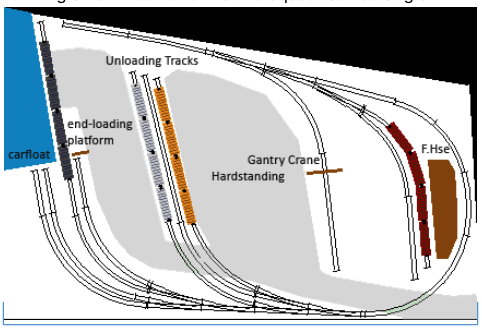
(2′ 6″ x 3′ 8′, N Gauge)
The Erie constructed one of the last harbor railroads in New York in 1927 on the Harlem river. The Erie originally shared the Harlem Transfer located further south with the CNJ and DLW until the turn of the 20th century, when was purchased outright by the Delware Lackwanna & Western. The 149th St. Station was operated through the Erie-DLW merger until 1970.
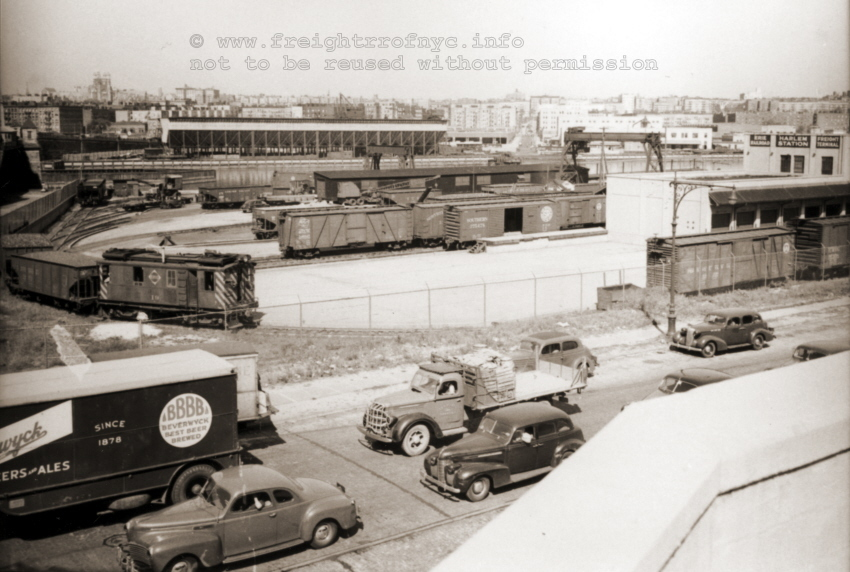
Despite the proximity of various large markets and break bulk facilities the terminal was rather spartan. Initially a long single story wooden freighthouse ran parallel to the river (grey cars in the above plan) – this was cleared and the site used for a end-loading dock for automobiles when the new concrete freight house was built at the other end of the lot in 1952. A 30t gantry crane in the centre of the facility was provided for heavy loads, and wide concrete roadways were provided for the other spurs – each customer having a particular spot.
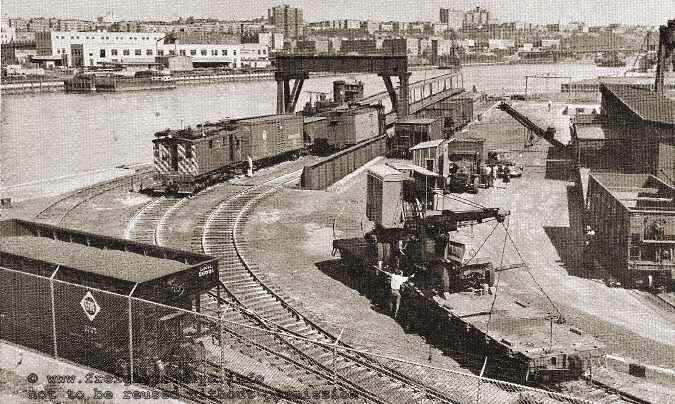
The terminal recieved loads via carfloat. Despite it’s small size, the entire facility had a capacity of 55 cars (the plan can handle 47). – Customers were Bay Transportation, Jerome Fuel Co., Mirandi Coal Co., National Carloading, Adolf Gobel, Gerosa Crane, United Cigar Box, HudFord and Brill.
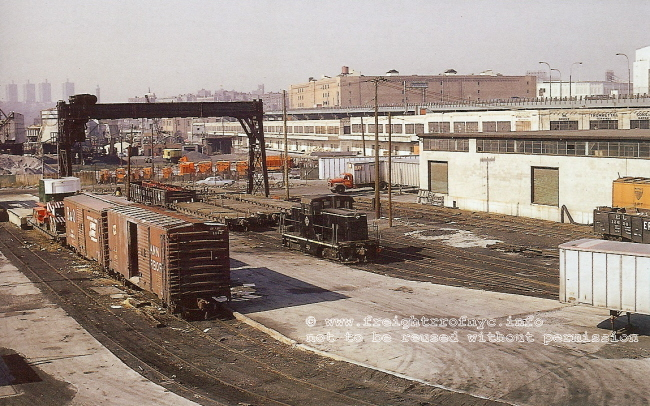
Inbound commodities such as: canned goods, heavy construction equipment, feed, grain, furniture, steel pipe, rugs, lumber and evaporated milk are listed as having been consigned through the Harlem Station. Another of the significant inbound commodities was coal. Outbound freight consisted of waste paper, rags, machinery and conveyors.
The terminal was switched initially by a boxcab diesel, then a GE 44-Tonner and then finally an Alco S1 until it was shut down.
I think this plan has many benefits: it’s tiny (less than 3×4), it only requires 9 turnouts (all Peco Small Radius), and keeps a minimum radius of 9″. It can support essentially unlimited operations with multiple carfloats. Up to 16 cars need to be switched per session (loads in, empties out) as well as support for switching-puzzles.
A drawback I can easily see is that as a dumpy oblong it won’t easily fit against the wall or fill a room like a more traditional layout – it might be better hidden in a coffee table or something, otherwise I could see it being stored under a bed and forgotten about.
LAJ / Vernon Yard
Inspired by a friend on RMweb’s astute observation of the areas around Vernon I realised there was an almost perfect track layout. As you can see below, there’s a large UP yard and mainline, a BNSF yard and the LAJ yard (a shortline liveried like the old ATSF)

This means that the basic traffic flow pattern for the area of railroad around Vernon goes something like this:

And again thanks to said friend I have a rough estimation of operations in Vernon’s industrial park:
- Inbound train arrives from Hobart BNSF interchange, LAJ District Blvd. Yard or UP East 26th Street Yard.
- Power cuts off leaving inbound cars at the entrance to the yard.
- Power pulls all outbound cars from the industries and dumps them in the fernow tracks at the end of the old mainline.
- Power switches all inbound cars onto correct spots.
- Power collects outbound cars from the fernow, blocks outbound cars into order (saves reclassifying them in the 26th St yard), runs round and pulls outbound cars back to 26th St. and the mainline.
This is obviously quite simplified, although it is making me wonder if there’s a way I can put the BNSF mainline in a different direction to simulate bridge traffic through the area – but I guess as an urban switching area there’d be very little through freight.
 Interlocking

You must be logged in to post a comment.