The Panhandle and Santa Fe is a stop-along-the-way on the ATSF’s secondary mainilne through Texas, set in the post war period of 1st generation diesels and steam locos.
Essential Details:
- Scale: N
- Size 11′ x 7′
- Control Method: DCC
- Track: Peco Code 55
Trackplan:
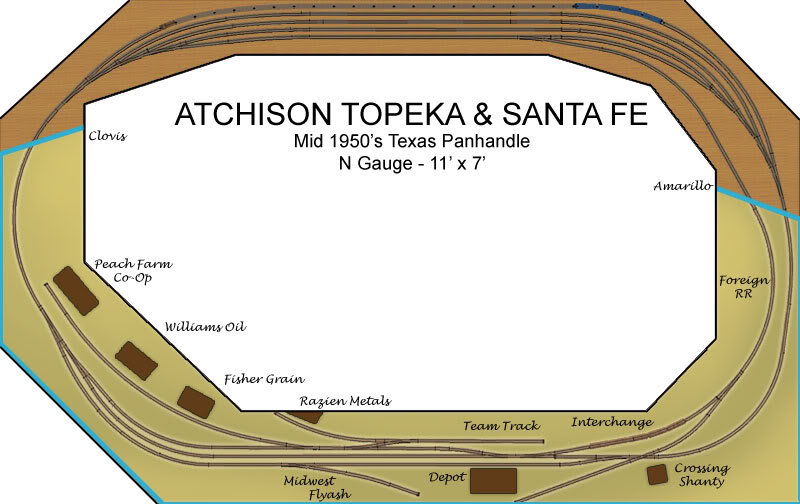
The town is a real-life layout design element taken from West Oklahoma.
The layout starts in the left hand corner, the mainline having just left the double-track CTC area southwest of Amarillo. The town is called Black and existed in real life, although the plan itself is tranposed from Woodward, Oklahoma. In the Woodward plan the interchange is a regional carrier, in my plan it is a branch of the Rock Island.
Operations:
As a diametric opposite to my previous layout Black River, PSF focuses on mainline freight. There are several scheduled fast-freight and passenger trains through the town (taken directly from the 1955 ATSF timetable for the Panhandle Subdivision) and both Rock Island and ATSF local freights powered by typical locomotives.
The layout is operated using manual switchlists.
Gallery:
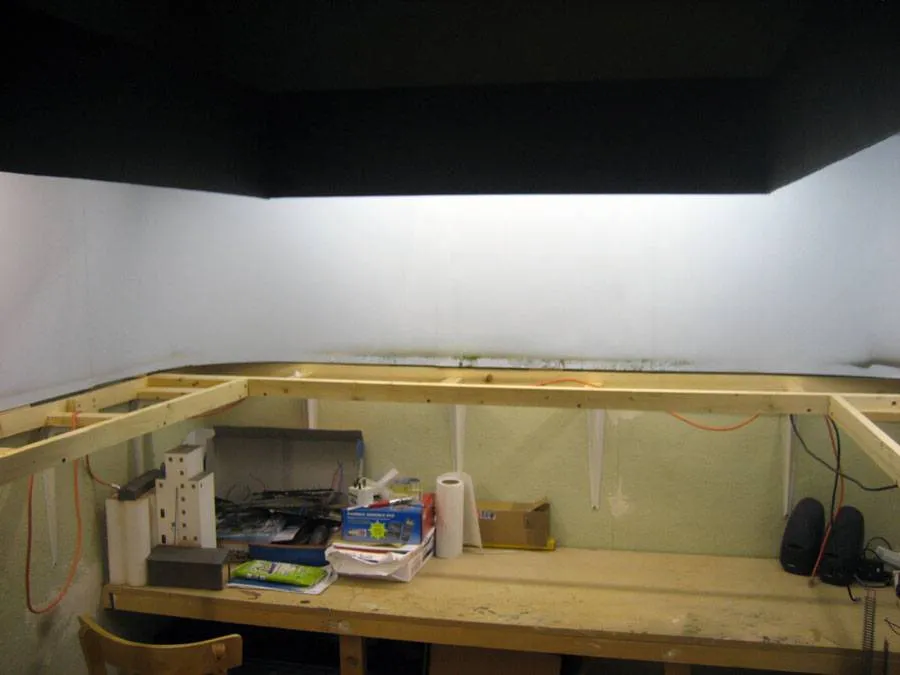
The PSF was built atop the baseboards for Black River:
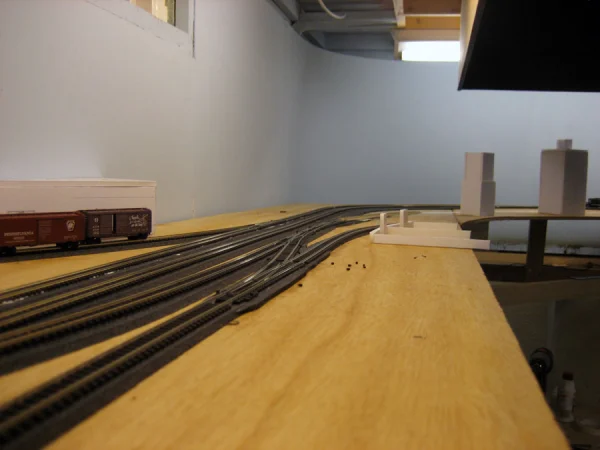
A couple of small pictures of the town scene, looking towards Clovis:
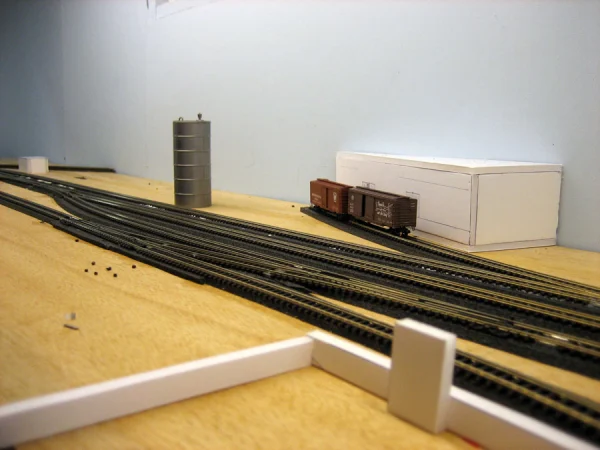
Looking towards Amarillo:
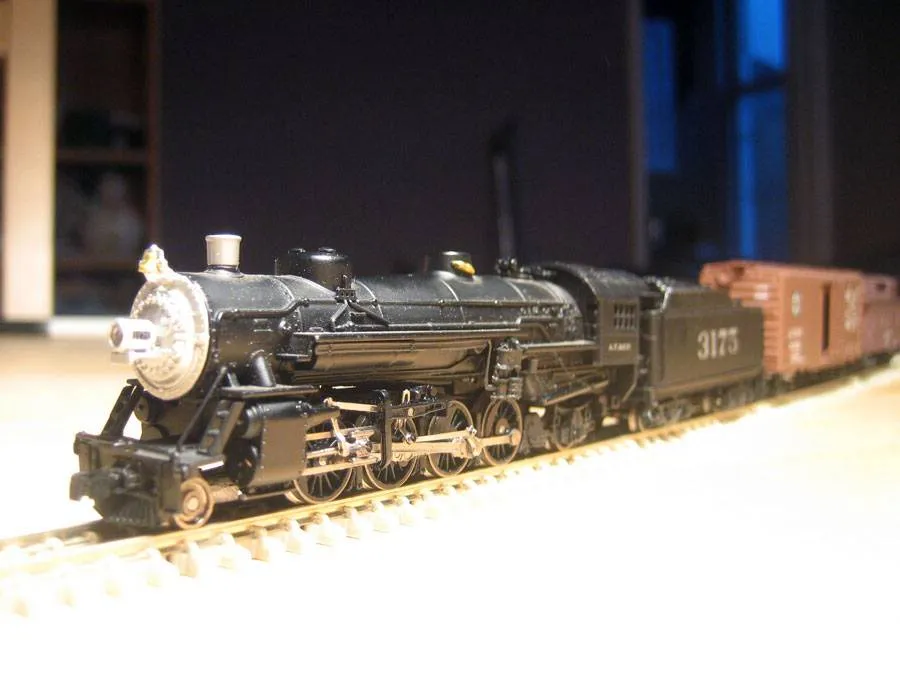
Some of the locomotive power for the layout was captured, first up a 2-8-2 Mikado:
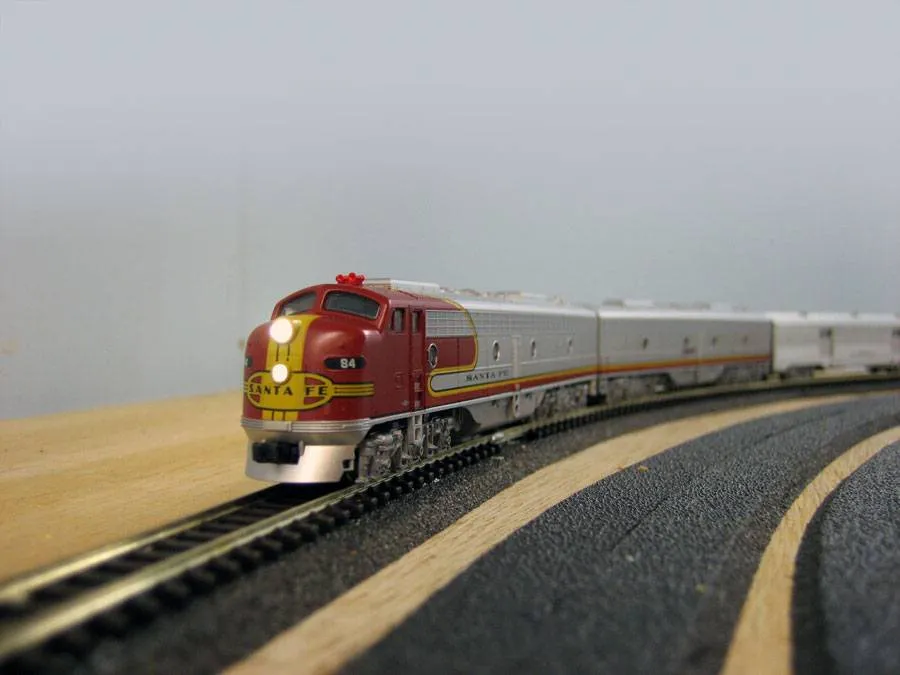
An E8 for the streamlined passenger services:
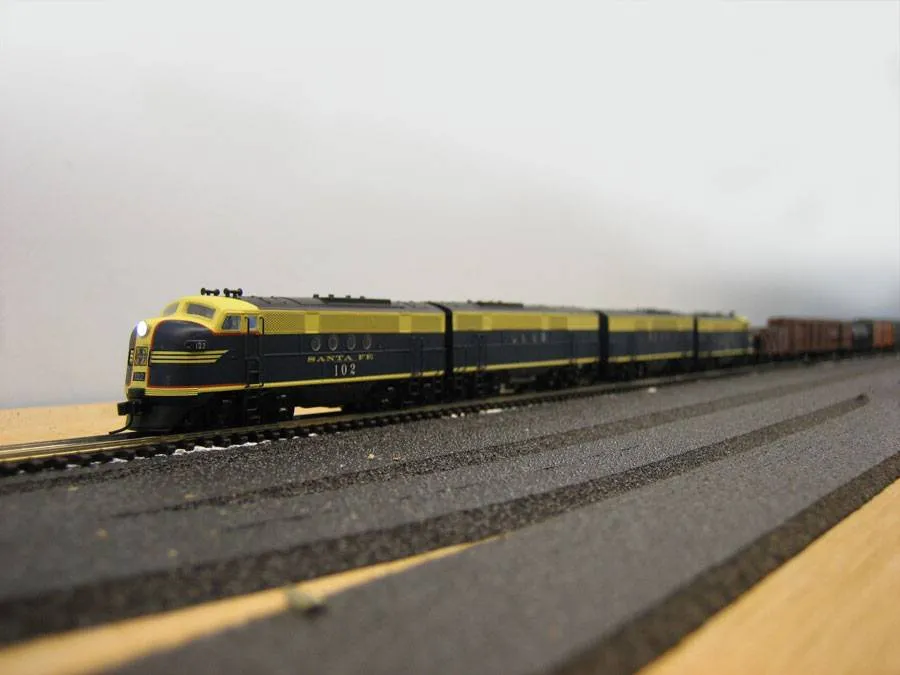
An FT A-B-B-A set for fast freight:
An F3 A-B set for mainline traffic:

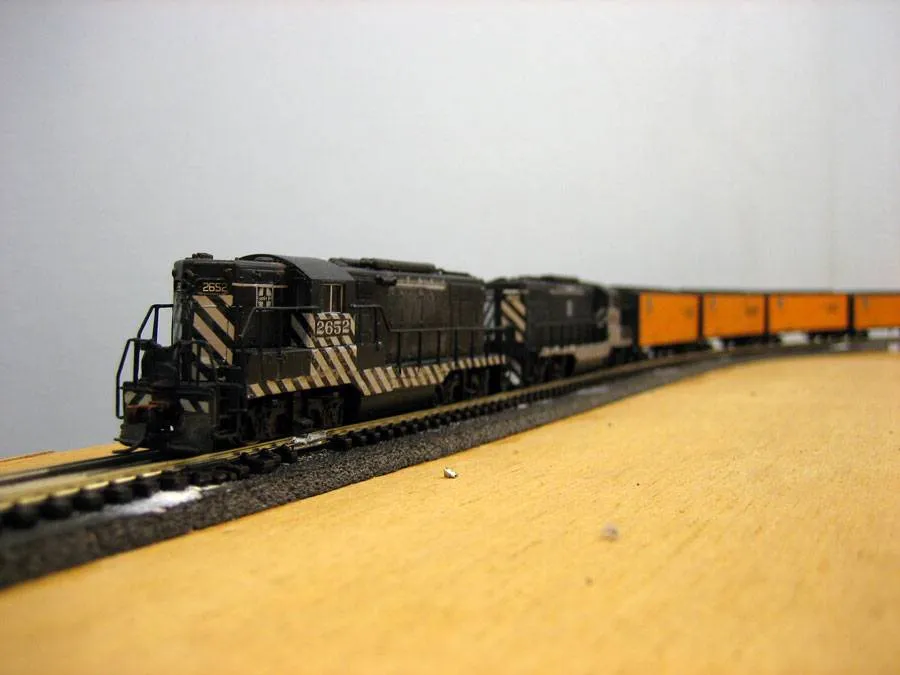
A pair of GP7 Switchers, custom painted and transfers:
A Fairbanks Morse H16-44:

The PSF interchanges with the Rock Island at grade, representing this turn is an Alco RS-3:

The most modern locomotive on the layout was an EMD SD24:
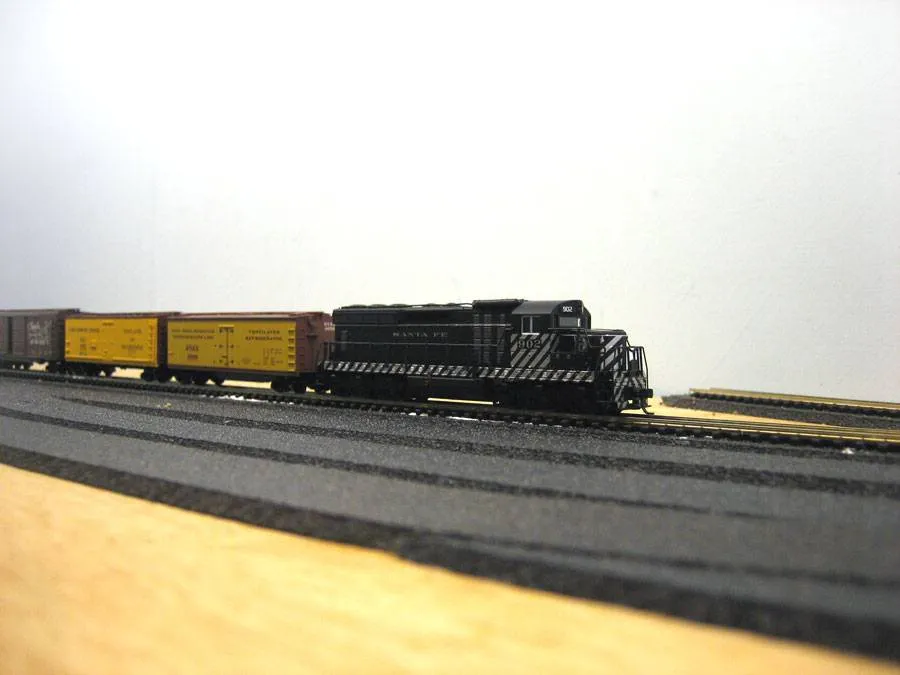
Positives:
N gauge provides for far more scope for variety in the design of a layout in a similar space to H0, and my eyes being relatively healthy I found very little to complain about for the switch. DCC made consisting of A+B+B+A matched sets very easy which would’ve required alot of fiddling in DC. Expansive staging made a the suspension of disbelief easier (although there was a drawback, see below) and the live interchange (where the RI had it’s own staging track and loco that operated) was a favorite feature of mine.
Negatives:
Because the staging was so huge (providing for four trains in either direction plus locals, plus RI trains, plus passenger trains) it created a situation where half of my layout room was off-scene in staging, and made the layout less an exercise in modelling the mainline and more an exercise in shoehorning as much operation in a town with no terminating or originating trains and twenty times the through-trains compared to those that stopped. Despite my best efforts I was unable to shake the feeling that I was compromising too much again, this time in the layout/staging ratio and the incredible lengths I was going to, to operate the layout like a switching plank.
Lessons Learnt:
- This layout would have been perfect as part of a larger whole with a yard or two and mainline stretches, with multiple operators. As the sole LDE however it’s design precluded lots of local operations and a number of through-trains that I couldn’t afford or operate.
- A balance is required between layout and staging space
- As a layout builder, operator and collector I simply cannot support mainline operations.
Operating Session
I was able to record my thoughts of an operating session on this layout, as follows:
Michael and I arrived back at my place after a few pints and a curry and sat down for a quick operating session I’d set-up beforehand.
The scheme is quite simple – ‘fast’ trains in alternating directions which drop off cars on the house track. Near the start is a Rock Island train which arrives from staging and switches the interchange, and near the end is an eastbound wayfreight which switches the industries and such. It was a great learning experience (as well as a generally nice time catching up with Michael) and I identified a fair few niggling issues (and some general observations) I’d have totally missed.
Each fast train had a switchlist with a few cars on the head end which were to be deposited on the house track. However, while the cars for Black were blocked at the front of the train, within that block themselves they were mixed up. Later in the session before the house track cars were switched more were added, so there were cars buried in the middle of the cut which were for eastbound facing industry spurs, and cars either side for westbound facing spurs – meaning ALOT of running around was required.
The solution to this is either pre-block the cars within the town ‘block’ for east and westbound facing spurs, or that a train only brings cars which are to be switched into spurs which are trailing in relation to their direction of travel, or that I have a wayfreight in each direction, and each only switches their trailing spurs.
The Rock Island interchange track is the busiest industry on the layout, with I imagine around 5-8 cars per session going through it, however without a dedicated runaround track it becomes difficult to handle. A compromise I made on the design was for the Rock Island interchange to be a single line and for the CRIP to use the sidings in down to run-around. What this means, however – is that the RI train needs to propel RI-bound cars currently on the interchange into one siding while pulling SF-bound cars behind it. Then runaround and on the other track cut off the SF-bound cars, finish the runaround and couple to the RI-cars, runaround back to the opposite end of the SF-bound cars and then reverse back onto the interchange, cutting off the SF-bound cars on the way before returning to home territory – ALOT of running around!
I think an design flaw that exacerbates the problem is that the main track (which is never blocked) spans either side of where the RI track connects. and requires the RI train to zig-zag to runaround cars it puts on the ‘industry track’ if there are cars also on the house track. This could be remedied by adding a runaround onto the RI interchange itself, requiring only the very smallest encroachment onto SF track – but would reduce the capacity of the interchange from 8 to 3 cars.
Another problem, despite my fastidious replication of a CLIC book plan did end up being the team track switchback. I kept it in the plan as something of a talking point, but it definately requires extending from it’s current 3+1 capacity to at least 5+1 if not larger to account for the space required to switch the cattle yard on it.
There were also a few minor technical issues that only surfaced on the day – the contact strips on the E8Am have come a bit loose again and need to be reset. The H-16-44 took a nosedive the previous night on running quality and needs to be looked at too. However, the real stars of the show were no doubt my GP7’s who performed extremely well over all of my track, with only one giant-finger-from-the-sky moment if I recall correctly.
 Interlocking
You must be logged in to post a comment.