Though the A1 is a widely known shunting locomotive for the LB&SCR and easily available in a number of liveries, but the more widespread E-class is slightly harder to find. Rapido’s E1 fills that gap to a degree, but an obvious choice for a trip-freight locomotive or heavyweight shunter with a degree of RTR availability is the E2:

The first batch of E2-class locomotives didn’t appear until 1913 and were generally unsuccessful freight engines. Most appear to have been based in Battersea or New Cross rather than the South Coast. However, when I saw a detailed Hornby E2 at a nice price I decided to grab it for the layout.

Backdating BR 32013 to LBSC 103
The model of 32103 had some problems – it was filthy both inside- and out, and it was an indifferent runner.
The model appears to have been cobbled together using an older Hornby E2 body with added detail, atop a more modern Thomas the Tank Engine chassis. Most frustratingly, the chassis was a weak friction-fit to the body, so it kept falling out!
Running Qualities
Cleaning helped the jerky and erratic running a little, but fitting a DCC chip made no further difference (it was my assumption that a more consistent high level of power would help). Fitting a large stay-alive chip also didn’t help smooth out the jerkiness, and it was only upon fishing out what I can only assume were well intentioned shims out of the bearing slots that the locomotive settled down to work smoothly.
Repainting
LBSC No. 103 would have been delivered in red-lined black at its introduction in 1913, so the model was cleaned thoroughly and sprayed with black aerosol primer. This was sealed with numerous coats of Future Floor Polish/Johnsons Klear to improve the surface for adhesion, and to better reflect the almost-pristine condition this loco would have been in.
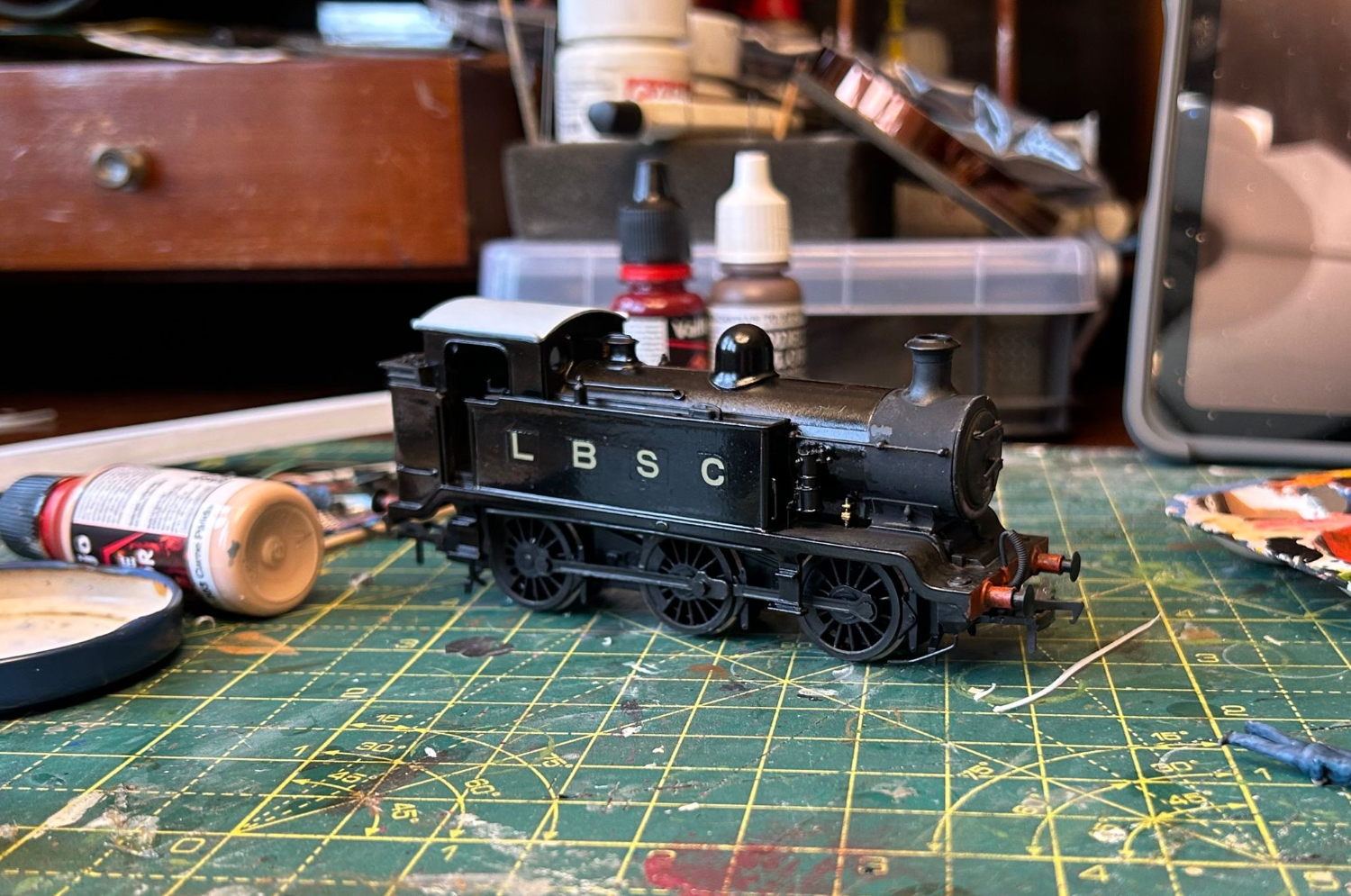
The L B S C lettering on 103 was sourced from EB Models’ “Marsh Umber” detailing set – it’s not strictly correct, and should be both smaller and yellow – rather than gold, but I am trying to seek comfort where I can on that account.
The red lining is from Fox Transfers set of miscellanious lining: https://www.fox-transfers.co.uk/general-alphabets-linings?colouralpha_lining=2707&lining_depth=1350

To Do
- Find a way to more permanently attach the body-shell to the loco
- Fit a smaller stay-alive that is not quite as troublesome to fit in the smokebox
- Finish the lining (i.e. another line on this side, and both on the other side (!)
- Light weathering, real coal
- Re-fit front coupling
- Fit a crew

 Interlocking
You must be logged in to post a comment.