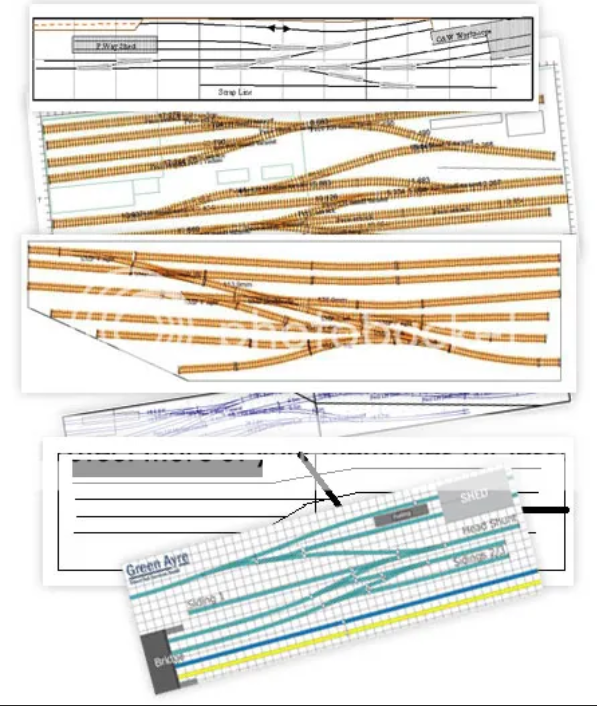
TMD’s are emblematic of a major problem with British railway modelling – a major disconnect from reality and a complete reluctance to even engage with it.
Craig Bisgeier of HousatonicRR.com posted an editorial on how John Allen’s Timesaver switching puzzle became wrongly integrated as part of a prototypical layout. Michael suggested that the same thing has happened in the with the UK modeller and these motive power depots.
“Says here that John Allen made up that design. He’s a pretty good modeler, that John Allen. If he designed it, it must be pretty good. Timesaver, huh?”
Craig Bisgeier
Though in Blighty we don’t tend to go for a Timesaver, our own particularly virulent strain of this is the ubiquity of a 5′ x 18″ TMD – often seen in the glossies (no doubt because it is an easy layout to photograph and describe) and therefore given legitimacy. But where did this originate?
Size
UK modellers often bemoan the small spaces they must be satisfied with in comparison to the general areas available to modellers in the US and Canada. Generally we don’t have much linear space, so a stumpy fat layout is preferable to a long thin one, and a 4′ x 2′ sheet of chipboard with a TMD diorama on it is stumpy and fat.
Sound
Though the UK was a latecomer to DCC by comparison with our American compatriots it is now in full flight, and a TMD allows people to show off their “novel” DCC loco features like constant lighting and sound.
The observed UK railway is passenger focused, and this gives a default position for most layouts – but there is a discordant note in that the multiple-unit centric operation of UK passenger operations, with frequent regional variations and livery changes make them less economically certain choices for commercial production than single locomotives – so there is often not very much work for a fleet of DCC sound-equipped freight engines to do.
Modelling a model
It’s also very easy to copy someone else’s layout – ‘a model of a model’.
Coal sidings are always switchbacks from goods depots, all branchlines single-track at the through and pass through a tunnel (above which is a bus stop and a Routemaster).
People are happy to use these clichés without examination.
Some of the ridicolous track plans seen for TMD’s would require a driver to make three reversing moves to get from a shed road to a fueling road. That this is both visually and operationally incongruent almost anything else on a model railway, it seems irrelevant to someone who has their Knightwing diesel point, a 47 and a Heljan diesel shed.
A place to put things
Every single modeller is guilty of the magpie-like desire for new shiny toys to play with so the fact that motive power is in no way proportional to the amount of stock owned isn’t a small consideration.
summary
The reasons for the development of the TMD style layout design are easy to see, as are the reasons that people continue to build them – be it shortage of space, excess of locos, layout copycatting, or novelty – but I feel they must be rejected – this is not railway modelling, it is arranging purchased locomotives on purchased track with purchased buildings with no regard for the railway itself. Take up flower arranging or doll house photography, instead.

 Interlocking
Leave a reply to Scott Cancel reply